
Alternative Provision
Alternative Provision (or ‘AP’ for short) refers to education in a setting other than a mainstream or special school for pupils having trouble accessing school as a result of their mental or physical health, social needs or emotional needs. We believe all children and young people, including those in alternative provision settings, deserve a high-quality education and the chance to fulfil their potential.
AP providers can offer high quality on-site or off-site tutoring or intervention services to meet children and young people’s varied and complex needs. Schools can use Alternative Provision to prevent exclusions or re-engage pupils in their education, whether this is a return to mainstream school, specialist provider or post-16 provision. Schools can also use AP to provide a vocational education option for some young people.
In Telford and Wrekin, we recognise that young people can have a range of complex needs and therefore our Alternative Provision offer is wider than just for young people with suspensions, exclusions or displaying poor behaviour in school.
Registered AP
Registered AP refers to settings that are registered with the Department for Education and Ofsted.This means they can take students directly on roll and that they are subject to inspections by Ofsted in the same way as mainstream schools.
In Telford and Wrekin, we have two main registered AP settings that are commissioned directly by the council, these are The Linden Centre (for young people aged 5 to 16) and Kickstart (for young people aged 14 to 16 – Years 10 and 11).
Un-registered AP
Unregistered AP refers to settings that aren’t registered with the Department for Education and therefore aren’t classed as a school and they don’t get inspected by Ofsted. This doesn’t necessarily mean that the provision isn’t as good as a registered AP, however, it does mean that the provision can’t provide all of the education for the young person, normally a maximum of 2 days per week.
Telford & Wrekin Council hold a list of unregistered AP, this is available through the AP Directory, and they ensure that the provisions are safe and meet the needs of young people. Unregistered AP is commissioned directly by the school where the young person is on roll.
How to access AP
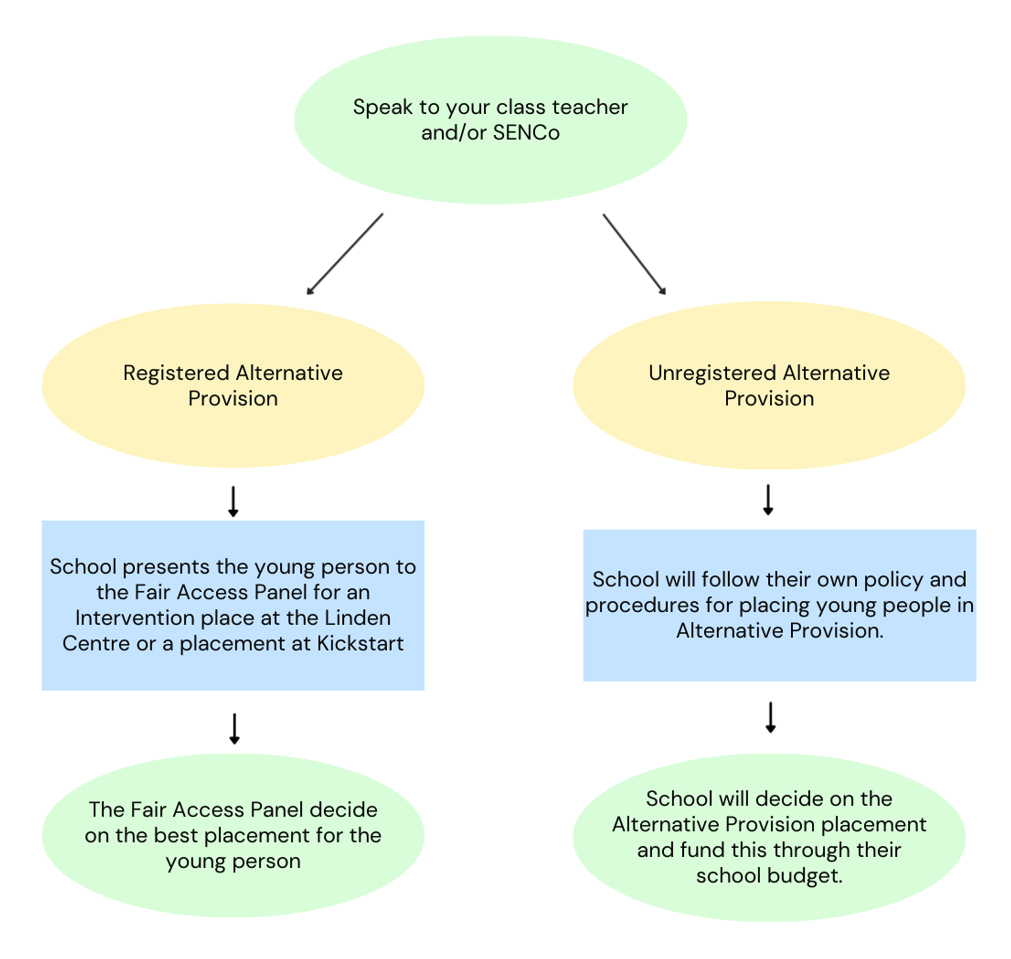
The first port of call for AP is to talk to your child’s school to explore whether this is appropriate and in what way the school can support your child with AP.
Registered AP
For The Linden Centre and Kickstart, the route into these Alternative Provisions is for your child’s school to present the case to the Fair Access Panel. The Fair Access Panel is made up of representatives from schools and from the Local Authority. The panel decides which young people would most benefit from the placement at The Linden Centre or Kickstart:
- The Linden Centre offers a programme of intervention places whereby the young person studies half days at the Linden Centre alongside half days in their mainstream school; usually for a period of 12 weeks, after which the young person returns full time to their mainstream school.
- Kickstart offers full time provision and most students tend to stay at Kickstart for the remainder of Years 10 and 11, although some students do reintegrate back into a new school.
The Local Authority also has a duty to provide education for permanently excluded young people. They will therefore name The Linden Centre (age 5 to 14) or Kickstart (age 14 to 16) as the provision from the sixth day of a permanent exclusion. We always aim to then provide a new mainstream school for the young person as quickly as possible.
Unregistered AP
For Unregistered AP, the school will be commissioning and paying for the young person to attend. Each school will have its own policy and procedures for placing young people in AP.
Your child’s school should be able to provide you with more details if required.
FAQs
What is the difference between Specialist and Alternative Provision?
Specialist Education refers to places within special schools, or specialist units attached to mainstream schools. They are permanent places (unless the child or young person's needs change significantly). A child would normally have an Education Health and Care plan which names this setting. Alternative Provision is usually intended to be a temporary placement; to address a child or young person's barriers to education and successfully prepare them for reintegration to school. A child wouldn’t normally have an Education Health and Care Plan.
What is the difference between a PRU an AP?
A Pupil Referral Unit (PRU) is the name give to an Alternative Provision that is run by the Local Authority. The Linden Centre is the only PRU in Telford and Wrekin. An Alternative Provision is a generic term that covers all settings offering support outside of school. This includes PRUs such as the Linden Centre; Alternative Provision Academies such as Kickstart and unregistered Alternative Provisions.
What is FAP?
The Fair Access Panel (or FAP) is a panel that is convened by the Local Authority; it is a statutory requirement that the Local Authority has a Fair Access Panel. The panel has two main purposes, firstly to ensure that there is a school place offered to every child of school age in the borough and secondly to ensure that no one school is asked to take a disproportionate number of young people that would challenge the resources of that school (called Hard to Place young people). All permanently excluded young people are presented to the FAP for a new school to be identified. Any young people that move into the area that can’t get a school through admissions are also presented. In Telford and Wrekin, the Fair Access Panel also decides which young people can be allocated places at The Linden Centre and Kickstart.
What happens if my child is not eligible for AP?
Every young person of school age is entitled to a full time education offer. If Alternative Provision is not appropriate for a young person, this offer will be either in a mainstream school or a special school.
Can I apply for a place in an Alternative Provision through the Admissions Process?
No, alternative provisions are not available through Admissions, you will need to talk to your child’s mainstream school if you believe that an Alternative Provision would provide the best education for your child.