
Educational Psychology Service
Information for schools and settings
Educational psychologists (EPs) help children and young people (C/YP) between the ages of 0-25 who are experiencing learning differences, social and emotional challenges, neurodiversity or developmental issues. EPs are highly trained professionals with expertise in psychological theory and practice, and a deep understanding of child and adolescent development.
In Telford & Wrekin, EPs collaborate directly with local schools, nurseries, and colleges to support CYP. Our work involves close partnership with educators and parent carers to address concerns related to learning, behaviour, wellbeing, and specific learning difficulties. This collaborative approach contributes meaningfully to the school’s graduated response, ensuring tailored support for each child or young person.
Meet the Team
We are a team of Educational Psychologists, Trainee Educational Psychologists and Assistant Educational Psychologists who apply psychology to support the wellbeing and progress of children and young people aged 0 - 25 years.
In 2025/26, each educational setting commissioning the EP service will be supported by a Lead EP, working in close partnership with a dedicated team of EPs, Trainee EPs and Assistant EPs. Together, they will co-create tailored action plans that reflect the unique context, strengths, and priorities of each setting in order to meet the needs of the communities we serve.

Educational Psychologists (EP) are psychologists trained in child and developmental psychology. EPs have completed a doctorate in psychology. They support families, schools and young people to understand and move forward with their current situations.
A Trainee Educational Psychologist (TEP) is a psychologist who is currently on the doctoral course, training to become a qualified educational psychologist. As part of their training, TEPs complete placements where they support schools and young people under the supervision of a qualified EP.
An Assistant Psychologist (AP) is a psychologist who has completed an undergraduate degree in psychology. An AP helps EPs with many different tasks including observations, training in schools or gaining pupil views from young people. Assistant Psychologists complete work under the supervision of a qualified Educational Psychologist and will often need to discuss their work with their supervisor before actions can take place.
Service Delivery Model
The diagram below represents our service delivery model, which is grounded in principles of neuro-affirming, inclusive, and anti-oppressive practice. At its core, the model is designed to support educational settings in cultivating environments where all children and young people feel valued, understood, and empowered to achieve.
We offer a comprehensive and responsive portfolio of professional development opportunities, aimed at building capacity across settings to meet the diverse and evolving needs of learners. Our training and support are informed by current psychological research and practice, with a strong emphasis on equity, belonging, and wellbeing.
Our approach is bespoke and collaborative. We work in partnership with settings to understand their context, identify priorities, and co-create solutions that reflect each setting’s values and aspirations. Through this process, we aim to foster sustainable change and promote inclusive cultures that actively challenge barriers to education and achievement.
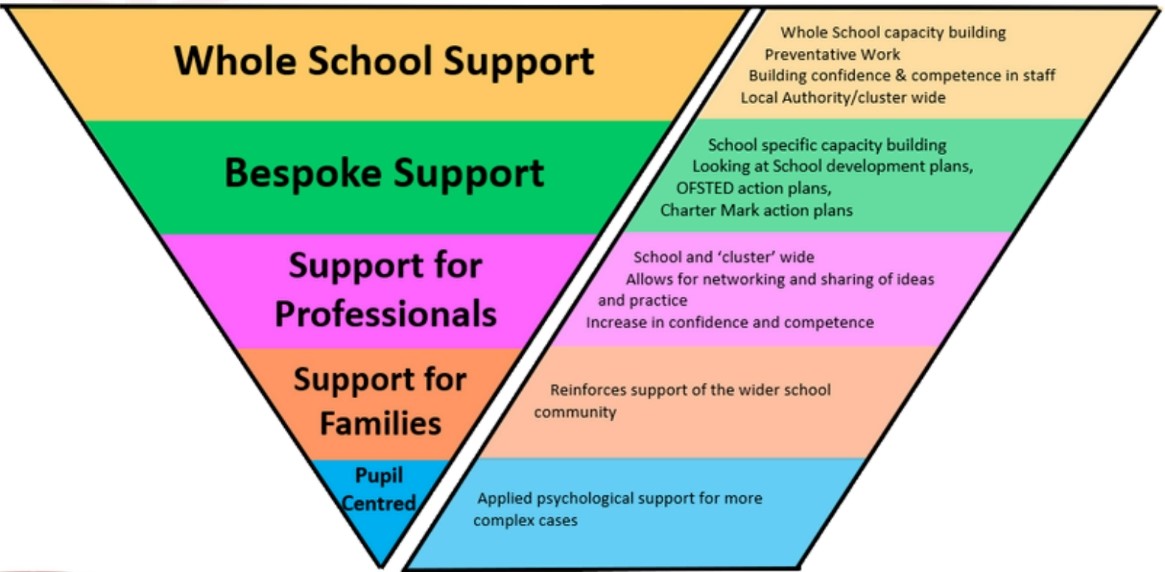
CPD and bespoke package options include:
Whole School Support
- Trusted Adult training
- Childhood Experiences of Attachment and Trauma
- Exploring Barriers to Education
- Emotion Coaching
- The Psychology of Learning
- Exploring the PACE approach
- An Introduction to Relational and Restorative Approaches
- Neuroaffirming and Inclusive Practices
Bespoke Support
- Precision Teaching
- Emotional Literacy in Schools
- SCERTS Project
- Relational and Restorative Approaches: PATH for Systems
- Embedding Neurodiversity & Inclusion: A Whole School Approach
- Bespoke Project Work
- Coaching Support for Professionals
- Solution Circles
- Supervision and Reflective Practice
Support for Families
- Parent/Carer Workshops
- Parent/Carer Drop Ins
- Community Conversations
- Home/school consultations
Pupil Centred
- Group Consultation
- Home/School Consultation
- Neurodiversity Outreach
- Circle of Adults
- Pupil Workshops
- Dynamic Assessment
- Planning Alternative Tomorrows with Hope (PATH)
Advancing Inclusive Practice: Developing a Neuro-Affirming Language Guide
From Words to Action: Our Journey to Co-create a Neuro-Affirming Language Guide
Language is more than words—it reflects our values and shapes identity. For neurodivergent children and young people, the language used by professionals can either affirm their uniqueness or unintentionally reinforce stigma. Recognising this, Educational Psychology Services across Shropshire and Telford & Wrekin embarked on a collaborative project to help change the narrative. We were mindful of creating a concise, ‘bitesize’ guide for busy practitioners—one that offers opportunities for insight, reflection, and practical implementation depending on individual need and capacity. The launch of this guide coincides with neuro-affirming practice training offers to schools and settings within our respective authorities, ensuring that professionals are supported to embed these principles into practice as part of a wider commitment to inclusive and person-centred approaches.
Supporting the SEND agenda through inclusive language
As part of our commitment to the SEND Code of Practice and local priorities relating to improving outcomes for children and young people with SEND in the communities that we serve, we recognise that language plays a critical role in shaping perceptions, fostering inclusion, and promoting equity. The development of a Neuro-Affirming Language Guide aligns with strategic objectives to embed person-centred approaches, reduce stigma, and ensure that neurodivergent identities are respected across education, health, and social care systems.
Why We Started
We consulted with families, practitioners, and neurodivergent individuals, mindful that traditional language used by professionals often felt clinical, deficit-based, and disconnected from lived experience. We wanted to do better. Our goal was simple yet powerful: create a resource that helps professionals speak—and write—in ways that affirm, respect, and empower neurodivergent identities.
The Collaborative Process
Led by EP teams, this resource was co-produced with colleagues from 0-25 and adult services through a multi-disciplinary approach involving:
- Neurodiversity practitioners
- Social care and health professionals
- Speech and language specialists
- Individuals with lived experience
Through workshops, reflective discussions, and shared learning, we explored how language impacts self-esteem, inclusion, and access to support. Every voice mattered. Every perspective shaped the guide.
What We Created
Our Neuro-Affirming Language Guide is a practical, evolving resource that includes:
- A glossary of key terms to clarify concepts
- Guidance on identity-first vs person-first language
- Language swaps to reframe deficit-based descriptions
- Principles for neuro-affirming writing and practice
- Reflection points to encourage ongoing growth
This guide is not about prescribing “correct” words—it’s about inspiring a shift in mindset. It invites professionals to move from a lens of deficit to one of strength, from control to collaboration, and from judgement to understanding.
Why It Matters
When we change our language, we change lives. Neuro-affirming language fosters dignity, autonomy, and belonging. It helps create environments where neurodivergent children and young people feel seen, heard, and valued.
Your Call to Action
If you work with children and young people—whether in education, health, or social care—this guide is for you.
- Download the Neuro-Affirming Language Guide
- Share it with your team
- Start conversations about how language shapes practice
- Commit to ongoing reflection and learning
Together, we can make neuro-affirming language the norm—not the exception.
Our Values
Collaboration
At Telford we work collaboratively with families, children and partner agencies, including health and social care to provide holistic support for children and young people.
Community
Community psychology focuses on building inclusive, supportive environments by working alongside communities to challenge inequality and promote inclusion. At Telford, we reach into the local community to offer psychological support.
Innovation
At Telford, we prioritize innovative ways to work with children and their families, using new and creative psychology to work at individual and systemic levels.
Wellbeing
We believe the wellbeing of children, families, teachers and school is central to all of our work. We promote whole school and individual wellbeing.
Our Projects
ELSA
Telford and Wrekin (TAW) EPS runs the ELSA initiative across Telford schools and settings. ELSA stands for Emotional Literacy Support Assistant. During the training, school staff learn about how to help children better manage their emotions. After the training, ELSAs receive ongoing supervision and CPD from the EP service.
PODS
We are proud to partner with PODS to support parent carers of children and young people with SEND. Through this collaboration, our team offers bookable sessions at PODS alongside school-based drop-ins and community projects, offering both group and individual sessions. These are designed to empower parent carers in their daily lives, providing practical, psychologically-informed support that reflects our shared commitment to inclusion.
Neuroinclusive Education Network (NEN)
Along with our Learning Support Advisory Teachers and Early Years specialists we provide whole school professional development through NEN training for primary, secondary and post-16 settings.
The Wellbeing Charter Mark
We are committed to whole school wellbeing practices through implementation of the pilot of the Sandwell Wellbeing Charter Mark.

Contact us
Schools and settings commissioning EP services will already know how to contact us directly.
For general SEND and inclusion enquiries, please use the shared email address: [email protected]